

How Have the Top 25 Most Popular College Majors Changed Over Time? – Updated 2026
Choosing a college major is one of the first big decisions a student will make in their lifetime. On a personal level, that decision will affect which schools they apply to, their career prospects, income, and potentially even where they’ll live. However, more broadly, the majors that new students gravitate toward can tell us a great deal about the economy, workforce demand, and where young people expect to see a return on their educational investments.
When large numbers of students begin moving toward certain fields and away from others, it’s usually the result of factors such as labor shortages, salary expectations, emerging technologies, and cultural attitudes.
To learn more about these trends, Student Choice analyzed 145,456 student loan applications submitted between January 2016 and May 2026 to determine how the most popular college majors have changed over the past 11 years.
Jump to Section
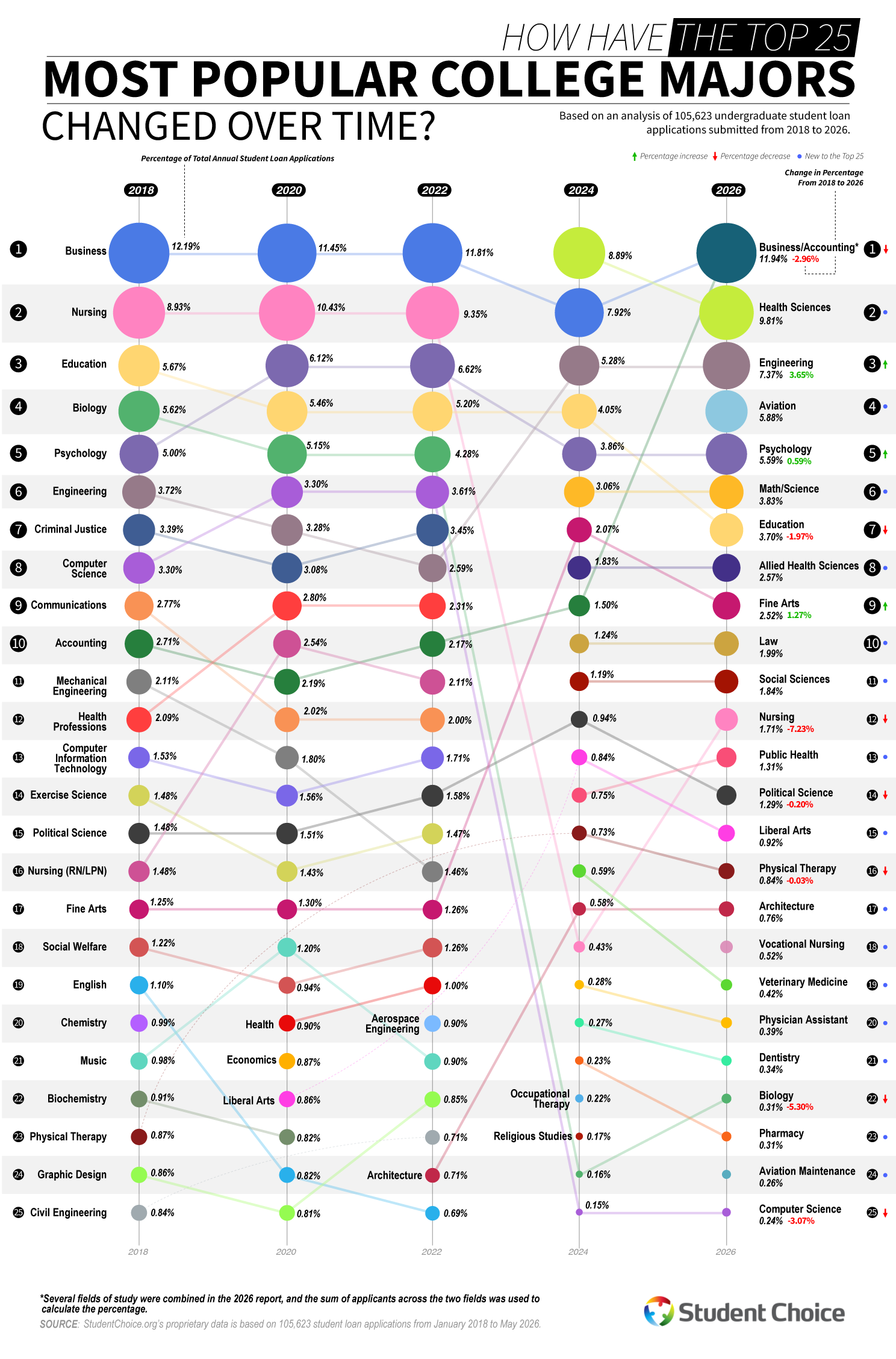
The Most Popular College Majors Over Time
Today (2026)
- Business/Accounting*
- Health Sciences +
- Engineering +5
- Aviation +
- Psychology -2
- Math/Science +
- Education -3
- Allied Health Sciences +
- Fine Arts +
- Law +
Four Years Ago (2022)
- Business
- Nursing
- Psychology +2
- Education -1
- Biology -1
- Computer Science +2
- Criminal Justice
- Engineering -2
- Health Professions +
- Accounting
Eight Years Ago (2018)
- Business
- Nursing
- Education
- Biology
- Psychology
- Engineering
- Criminal Justice
- Computer Science
- Communications
- Accounting
Key Trends Since 2016
Business Remains on Top—For Now
Business has held the number one position for most of the period studied. From 2017 through 2023, it commanded between 11.45% and 12.81% of all student loan applications. Despite remaining the most popular choice, the category has lost ground overall, particularly in 2025, when the major’s share of applications dropped to just 5.27%. In 2026, the major returned to first place, likely because accounting and business were merged in this year’s report.
Healthcare Has Expanded Beyond Nursing
Unsurprisingly, healthcare-related fields remain popular, though there have been some shifts in recent years. Nursing consistently ranked among the most popular majors for many years, peaking at 10.87% of applications in 2023. However, by 2026, nursing applications dropped to just 1.71%. Meanwhile, health sciences ranked second overall at 9.81%, while allied health sciences, public health, physical therapy, physician assistant studies, dentistry, and pharmacy all appeared in the top 25.
Engineering and Aviation are Some of the Fastest Growing Majors
Incoming college students are paying attention to where the jobs are, and it’s clear they are putting their hopes in engineering. In 2017, the major accounted for just 3.91% of applications, but by 2026 that figure had reached 7.37%, a gain of 3.46 percentage points, making it one of the strongest growth stories in the dataset.
Aviation is another rapidly growing field. It did not make the top 25 until 2025, where it emerged as the most popular major in the dataset. In 2026, it ranked fourth overall at 5.88%. Aviation maintenance has also recently entered the rankings, suggesting growing student interest in the broader aviation industry, likely due to ongoing pilot shortages and workforce demand.
Psychology Continues to Grow
While most majors have fluctuated in popularity over time, psychology has seen surprisingly steady growth over the past decade.
Applications have increased from 4.99% in 2017 to 5.59% in 2026. While there is some debate about the job market viability of a psychology degree, students clearly see value in the field, whether as a standalone career path or as a foundation for graduate-level work in therapy, counseling, law, and medicine.
Computer Science Took an Unexpected Turn
Computer science was one of the fastest-growing majors during the early years of the study, rising from 2.95% of applications in 2017 to 3.61% in 2022. However, by 2026, it accounted for just 0.24% of applications and ranked twenty-fifth overall. Of course, part of this decline may be related to changes in reporting categories beginning in 2024, including the introduction of math/science as a combined field, but it’s possible that the volatility of the tech job market has scared prospective students away.
Liberal Arts and Education Lost Ground, While Fine Arts Grew
Over the past decade, several historically popular majors have experienced steep declines in applications. Education fell from 5.99% of applications in 2017 to 3.70% in 2026. Sadly, teacher wages have not kept pace with other fields, and students don’t seem to foresee a return on their investment as a result. Communications also lost ground over the period, while majors such as English and history no longer appeared among the top programs.
At the same time, interestingly, fine arts moved in the opposite direction, increasing from 1.35% to 2.52% of applications, earning a place in the top ten by 2026.
What the Data Shows
The biggest winners over the past 11 years were healthcare-related fields, engineering, psychology, and aviation. Meanwhile, previously popular majors like education, biology, nursing, and computer science all saw considerable declines.
In addition to those changes, the rankings indicate that students are increasingly specialized, pursuing a wider range of career-focused programs across healthcare, engineering, aviation, and other professional fields.
No matter which major you choose, paying for college remains one of the most important considerations in the decision. Student Choice helps students and families find financing solutions that make higher education more affordable. Whether you’re a new student or looking to refinance, we’re here to find student loan solutions that help you move forward with confidence.
Our Data (2016-26)
The Most Popular College Majors 2016
The Most Popular College Majors 2017
The Most Popular College Majors 2018
The Most Popular College Majors 2019
The Most Popular College Majors 2020
The Most Popular College Majors 2021
The Most Popular College Majors 2022
The Most Popular College Majors 2023
The Most Popular College Majors 2024
The Most Popular College Majors 2025
The Most Popular College Majors 2026
*Several fields of study were combined in the 2026 report, and the sum of applicants across the two fields was used to calculate the percentage.
Let Us Help You.
Student Choice offers competitive private student loans and student loan refinancing through credit unions, allowing students to work with lenders that they use and trust to fund their futures, regardless of which college major they choose.
Source:
StudentChoice.org’s proprietary data is based on 145,456 student loan applications from January 2016 to May 2026.
