You did it! The cap went up. The photos are on Instagram. Your family is proud, your professors are relieved, and somewhere in a pile of cards there’s a check from your aunt with a note that says “for your future.”
Here’s the part nobody mentions during the ceremony: you’re about to enter a financial transition that matters more than most of what you studied senior year. The Class of 2026 is in a unique spot. You’re the last group of undergrads in decades who borrowed entirely under the old federal student loan rules, and you’ll be the first to repay under the new ones shaped by the One Big Beautiful Bill Act.
The average graduating senior in 2026 is carrying roughly $30,000 in student loan debt. That number means very different things depending on your degree, your job prospects, and whether you have a plan. And right now, most graduates don’t.
That’s not a reason to panic. It is a reason to spend a few hours this summer making smart moves instead of winging it. Let’s walk through what actually matters before your first payment arrives.
Your 6-Month Grace Period (Use It, Don’t Waste It)
After you graduate (or drop below half-time enrollment), federal student loans (and many private student loans) give you a six-month grace period before your first payment is due. If you walked in May, your first payment will land around November or December 2026.
Most people treat that grace period like a vacation from thinking about loans. That’s a mistake.
Here’s why the grace period is valuable: interest is still accruing on any federal unsubsidized loans during those six months. It doesn’t pause just because your payments do. So every month you wait to make a plan is a month that balance quietly grows.
What you should actually do with those six months:
- Month 1: Log into StudentAid.gov and confirm your total balance, loan types, interest rates, and servicer. Write it down somewhere you won’t lose it.
- Month 2: Research your repayment plan options (more on that below).
- Month 3: Check what current rates look like in the private market, even if you’re not sure about refinancing yet.
- Months 4-6: Make a decision and set up autopay before the first bill surprises you.
A quick note on subsidized vs. unsubsidized loans: If you have subsidized loans, the government covers interest during your grace period. Unsubsidized loans? That interest is all yours. Check your loan breakdown at StudentAid.gov so you know which category your balance falls into. If most of your debt is unsubsidized, you might even consider making small interest-only payments during the grace period to keep that balance from growing.
The grace period isn’t free time. It’s planning time. Use it that way and you’ll start repayment with confidence instead of confusion.
Picking a Repayment Plan in 2026 Is Different Than It Was in 2024
Two years ago, the SAVE plan was the shiny new option everyone was talking about. Then the courts froze it, and eventually the OBBB replaced it entirely. If you were counting on SAVE’s generous terms, that ship has sailed. We wrote a full breakdown of what happened to SAVE and what replaced it.
So what’s left? For the Class of 2026, your federal repayment options come down to a few key paths:
- Standard Repayment: Fixed monthly payments over 10 years. Straightforward, predictable, and you’ll pay the least total interest. Best if your income supports it.
- Income-Based Repayment (IBR): Payments based on your income and family size. Good if you’re starting with a lower salary. Forgiveness after 20-25 years of qualifying payments.
- Repayment Assistance Plan (RAP): The OBBB’s new income-driven option. Payments range from 1% to 10% of your adjusted gross income, with forgiveness after 30 years. It’s designed to replace SAVE, but the terms aren’t as generous.
The plan you choose matters more than most grads realize. Picking the wrong one can mean overpaying by thousands, or ending up in forbearance because monthly payments are too high. Check out our detailed guide to choosing a repayment plan that’s worth 10 minutes of your time.
A few things to keep in mind: if you’re pursuing Public Service Loan Forgiveness (PSLF), you need to be on an income-driven plan and working for a qualifying employer. Don’t accidentally opt into Standard Repayment and lose years of progress toward forgiveness.
Also worth noting: the RAP plan’s forgiveness timeline of 30 years is significantly longer than what SAVE promised. For many borrowers, especially those with smaller balances, Standard Repayment might actually cost less over time even though monthly payments are higher. Run the comparison before you commit. A higher monthly payment that ends in 10 years can beat a lower one that stretches for three decades.
Should You Refinance Right Out of School?
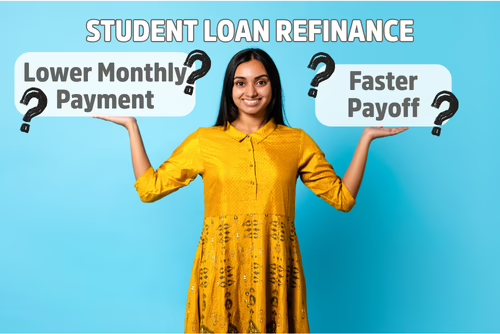
Let’s be honest: for most brand-new graduates, student loan refinancing isn’t the right move on day one. Here’s why.
Refinancing means taking out a new private loan to replace your federal loans. You potentially get a lower interest rate, but you give up federal protections like income-driven repayment, forgiveness programs, and deferment options. To get the best refinance rates, lenders want to see a strong credit score, stable income, and a reasonable debt-to-income ratio. Most fresh grads are still building all three.
But here’s the exception: If you graduated with a degree in a high-demand field (think nursing, engineering, computer science, or accounting) and you already have a signed offer letter with a solid salary, your refinance math might look different. Some lenders offer competitive rates even for newer borrowers, especially with a cosigner.
The numbers to watch: Federal undergraduate loans for the Class of 2026 carry a rate of 6.39%. Private refinance rates for well-qualified borrowers can start as low as 3.99% fixed. That gap is significant over a 10-year repayment period.
Here’s a practical approach:
- Don’t refinance on impulse. Wait until you’ve been employed for a few months and have a clearer picture of your monthly budget.
- Pre-qualify first. Most lenders use a soft credit pull, so shopping rates won’t hurt your credit score. Compare rates to see what you’d actually qualify for.
- Keep federal loans separate if you need flexibility. You can always refinance later. You can’t un-refinance back into federal protections.
- Consider refinancing only your high-rate loans. If you have a mix of subsidized (lower rate) and unsubsidized (higher rate) loans, you can refinance selectively.
If your rate drops by even 1-2 percentage points, the savings on a $30,000 balance add up to thousands over the life of the loan. On a 10-year term, dropping from 6.39% to 4.5% saves you roughly $3,200 in total interest. That’s real money. And if the numbers don’t work today? Revisit in a year. We wrote a whole piece on refinancing student loans more than once because your financial picture changes faster than you’d think. The rate you get six months into your first job could look very different from the rate you’d get after 18 months of on-time payments and a growing credit history.
The One OBBB Rule That Could Trip You Up
This is the one that will catch people off guard, so pay attention.
Under the One Big Beautiful Bill Act, if you take out any new federal student loan after July 1, 2026, all of your existing federal loans get pulled under the new repayment rules. Not just the new loan. All of them.
Why does this matter for the Class of 2026? Because some of you are going to grad school.
Let’s say you graduated in May 2026 with $27,000 in undergrad loans borrowed under the old rules. You’re on IBR, making manageable payments, and everything is going fine. Then you start a graduate program in Fall 2026 and take out a new federal loan to cover tuition.
The moment that new loan disburses after July 1, your old undergrad loans are now subject to the OBBB’s repayment framework too. That could mean different payment calculations, different forgiveness timelines, and potentially higher costs depending on your plan.
If you’re considering grad school, this is worth thinking through before you enroll. Some options:
- If your grad program starts before July 1 and you can lock in borrowing under the old rules, do it. (The three-year transition window could protect you.)
- If grad school starts after July 1, understand that any new federal borrowing resets the rules for everything.
- Consider whether private student loans for grad school might let you keep your undergrad loans under the old system.
This isn’t about avoiding grad school. Plenty of programs are still worth the investment. It’s about going in with your eyes open and structuring your borrowing so you don’t accidentally trigger rules you didn’t know existed. A little planning now prevents a lot of frustration later.
A Month-by-Month Timeline: Graduation to First Payment
If all of this feels like a lot, here’s a simple timeline to follow. Tear it out, screenshot it, tape it to your bathroom mirror. Whatever works.
May 2026: Graduation Month
- Confirm your total loan balance and servicer at StudentAid.gov
- Set up a simple spreadsheet or notes file with your loan details
- Enjoy the moment (you earned it)
June 2026: Research Month
- Read up on repayment plan options: Standard, IBR, and RAP
- If considering grad school, research the OBBB transition rules
- Start tracking your monthly income and expenses
July 2026: Rate Shopping Month
- Check current refinance rates even if you’re just browsing
- Pre-qualify with 2-3 lenders (soft pull, no credit impact)
- Decide whether refinancing makes sense now or later
August 2026: Decision Month
- Choose your repayment plan and submit your selection
- If refinancing, start the application process
- Set up autopay (most servicers and lenders offer a 0.25% rate discount for it)
September-October 2026: Prep Month
- Confirm your first payment date and amount
- Build a small emergency fund buffer (even $500-$1,000 helps)
- Review your employer benefits for any student loan repayment assistance
November 2026: Game Time
- First payment hits. You’re ready because you planned for it.
- Set a calendar reminder to revisit your plan every 12 months. Income changes, rates shift, and better options appear.
- If you’re on an income-driven plan, make sure to recertify your income on time. Missing the deadline can spike your payments temporarily.
The Class of 2026 didn’t get the easiest hand when it comes to student loans. New rules, fewer federal options, and a repayment landscape that’s still settling into place. But you also have something earlier graduates didn’t: better information, more competitive private rates, and a six-month runway to get it right.
See what refinance rates look like for your balance and start your post-graduation plan with actual numbers, not guesswork.
*Important: Please remember that federal loans do offer certain benefits and protections that do not transfer to a private loan. By refinancing your federal student loans to a private loan you will lose any federal benefits that may apply to you. Please review this important disclosure for more information.
Loans subject to credit approval and additional criteria. Carefully consider whether consolidating your existing student loan debt is the right choice for you. Any reduction in your monthly payment may result from a lower interest rate, a longer repayment term, or both. Extending the loan term could increase the total interest paid over time.