August arrives faster than any college student wants to admit. And every year, thousands of families scramble to figure out financing in the final weeks before tuition is due.
The families that avoid that panic are the ones who treat summer like a countdown, not a vacation from financial planning.
Here’s your week-by-week playbook from now through fall semester. Print it. Tape it to the fridge. Check things off as you go.
Early to Mid-June: Get Your Numbers Straight
This week, answer three questions:
- What does your school actually cost? Not tuition alone. The full cost of attendance: tuition, fees, room, board, books, transportation, personal expenses. Your school’s financial aid office publishes this number.
- What does your aid package cover? Add up every grant, scholarship, federal loan, and work-study award. Subtract that from the cost of attendance. The remaining number is your gap.
- How will you fill the gap? Savings, family contributions, student earnings, additional scholarships, or borrowing. Knowing the gap now means you have 8 to 10 weeks to address it calmly instead of 8 to 10 days.
If the gap is bigger than expected, read our parents’ guide for a clear breakdown of options.
Late June: Lock Down Your Borrowing Plan
If you’re going to borrow beyond federal student loans, this is when to act. Here’s why:
- Private loan applications take time. Credit checks, cosigner verification, school certification, and disbursement processing typically take 2 to 4 weeks. Starting now means funds arrive before the first tuition bill.
- Rates can move. Interest rates aren’t frozen. Waiting until August risks higher rates or less favorable terms. For context on why timing matters, see why locking a rate early matters.
- Being prepared matters. Having your documents ready (tax returns, pay stubs, school enrollment verification) speeds up the process.
Action step: Compare rates from credit union lenders.1 Run the numbers for your specific loan amount and term. Many lenders let you estimate rates without a credit pull, so it doesn’t affect your score.
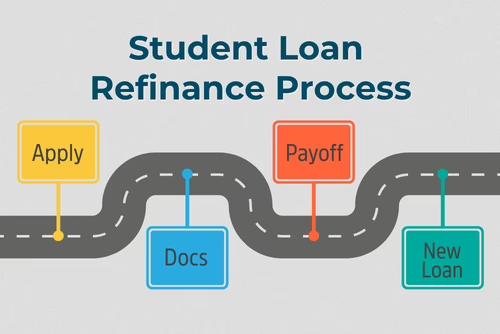
Early July: Complete Your Application
Whether you’re applying for a private student loan, finalizing federal aid, or both, this is the window.
For federal loans:
- Accept your loan package through your school’s portal
- Complete entrance counseling at studentaid.gov (required for first-time borrowers)
- Sign your Master Promissory Note (MPN)
For private loans/education lines of credit:
- Submit your application with your cosigner (if applicable)
- Provide requested documentation promptly
- Confirm your school’s certification process (your lender will contact your school to verify enrollment and costs)
For both:
- Set up a dedicated email folder for loan correspondence
- Save every confirmation email and reference number
- Note your expected disbursement date
Mid-July: Follow Up and Prepare for Disbursement
This is the “don’t assume everything is fine” phase.
- Check your application status. Log into each lender’s portal. If anything is listed as “pending” or “needs documentation,” handle it now. A missing document can delay disbursement by weeks.
- Confirm disbursement timing with your school. Financial aid offices can tell you when federal and private loan funds will be applied to your account. Make sure this happens before the tuition due date (or know what happens if it doesn’t, since most schools have a process for this).
- Set up autopay. If your lender offers an interest rate reduction for automatic payments (many credit unions offer 0.25% off), enroll now. It’s free savings for the life of the loan.
Late July: Build Your Repayment Awareness
You don’t need to start repaying yet, but you should understand what’s coming.
- Calculate your expected monthly payment. For every $10,000 borrowed at 6.5% over 10 years, expect about $113 per month. For $25,000, that’s roughly $283. For $50,000, it’s about $567.
- Know your grace period. Federal loans give you six months after graduation or dropping below half-time. Private loan grace periods vary by lender.
- Understand interest accrual. Unsubsidized federal loans and most private loans accrue interest while you’re in school. Making interest-only payments during school (even $25 to $50 per month) can save hundreds over the life of the loan.
August: Final Checks Before Classes Start
Two weeks before your first class:
- Confirm all loan funds have been applied to your student account
- Verify your student account balance shows zero (or the amount you owe out of pocket)
- If you have a refund (loan funds exceeding charges), know when it will be issued and budget it carefully for books, supplies, and living expenses
- Save your loan servicer’s contact information
- Bookmark studentaid.gov for federal loan management
Why This Timeline Matters
Every year, schools report that students who miss the financing deadline face late fees, dropped course registrations, and delayed starts. A week-by-week plan isn’t about being Type A. It’s about protecting the investment you’ve already made in getting admitted.
The work you do this summer is the foundation for a financially manageable academic year. Don’t leave it for August.
For help choosing the right private student loan, compare education line of credit options at Student Choice. Your future self will thank your summer self.
–
1Subject to credit qualification and additional criteria. Savings or lower interest rates are not guaranteed and depend on your individual financial profile, loan terms, and credit history.