

The Most Popular College Degrees Ranked by Return on Investment (ROI) After 5 Years in the Workforce – Updated 2026
With the average cost of college now exceeding $43,000 per year, students face difficult questions long before entering the workforce. Will this degree lead to strong career opportunities? Will the salary justify the cost of tuition? How long will it take to see a meaningful return on that investment?
While majors should ideally be chosen based on personal interests, for many, college is one of the biggest financial commitments a family or student will make in their lifetime. For that reason, return on investment (ROI) is an increasingly important part of the decision-making process.
To determine which fields offer the strongest financial outcomes, Student Choice analyzed the most popular college majors among students in 2026 and compared them with earnings data from the U.S. Bureau of Labor Statistics to identify the strongest ROI.
Jump to Section
Highest ROI Degrees
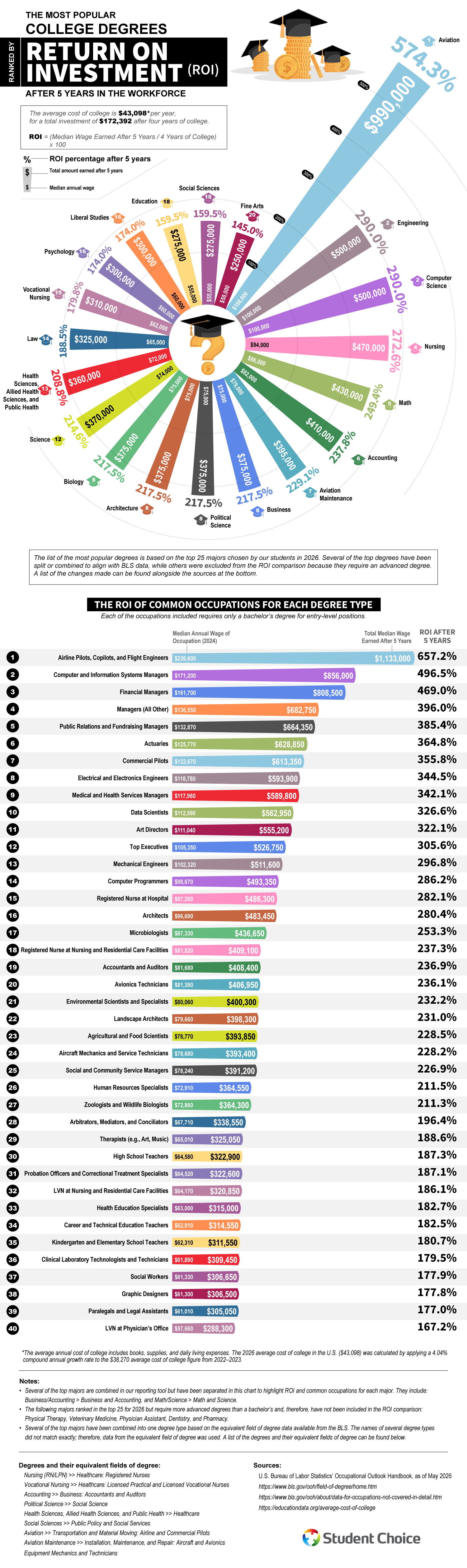
Aviation claimed the top spot this year by a significant margin, with a 574.3% ROI after five years. Workers with aviation degrees earn a median annual wage of $198,000, placing the field well ahead of every other major in the study. In recent years, aviation has emerged as one of the fastest-growing areas of student interest, likely due to the impending pilot shortage as seasoned airline workers begin to retire.
Behind aviation, engineering and computer science are tied for second place, each with a 290% ROI. These fields have long been associated with high salaries (both have median starting wages of $100,000) and, as such, continue to offer some of the best financial outcomes for bachelor’s degree holders.
Healthcare continues to perform well, with nursing ranking fourth at 272.6% ROI. Meanwhile, health sciences, allied health sciences, and public health collectively generate a 208.8% return. Healthcare has traditionally been a safe option, thanks to its stability and job availability.
Math and accounting also rank among the top tiers, with returns of 249.4% and 237.8%, respectively. Foundational fields like business, political science, architecture, and biology are tied for 8th place, each offering a steady 217.5% return on investment, based on a median annual wage of $75,000.
Interestingly, despite producing a lower ROI than many other healthcare-focused majors, psychology remains one of the most commonly selected fields of study. With a median salary of $60,000 per year, it offers a 174% ROI after five years.
Overall, the rankings indicate a growing preference for specialized, career-focused degrees. Students appear increasingly interested in fields that offer clear pathways into established professions with strong job market demand.
Best ROI Careers for Popular Majors
According to our research, choosing the right job after graduation can yield a payout that far exceeds the baseline average for a major. For instance, while an aviation degree yields a massive median return, students who become airline pilots, copilots, or flight engineers achieve an astronomical 657.2% return on investment, with a median annual wage of $226,600. While slightly lower, commercial pilots still see a 355.8% return after five years.
Computer science majors earn the highest pay by moving into management or highly specialized roles. Computer and information systems managers achieve a 496.5% return on investment, with a median salary of $171,200, while computer programmers earn a healthy 286.2% return. Business majors also find similar success in leadership positions; becoming a financial manager yields a 469% return, and stepping into top executive roles provides a 305.6% return.
Even fields that rank lower in the overall degree ranking can yield spectacular rewards if students target specific niches. For example, math majors who become actuaries earn an impressive 364.8% return, while those working as data scientists earn 326.6%. Fine arts majors, which rank near the bottom of the degree list at a 145% return, can pivot into highly lucrative roles like art directors, achieving a 322.1% return and a median salary of $111,040. Public relations and fundraising managers with a political science background enjoy a 385.4% ROI and a median annual wage of $132,870. Medical and health services managers secure a 342.1% return, reaffirming that management and administration across many fields remain lucrative career options for those seeking high returns on their educational investments.
Is College Still Worth the Price Tag?
With the average annual cost of college climbing to $43,098, a four-year degree requires a baseline investment of $172,392. Faced with these numbers, many prospective students face hard conversations about whether traditional higher education remains a smart gamble. Taking on tens of thousands of dollars in student debt can feel like a heavy anchor, especially when entry-level salaries in fields like education or the social sciences yield a more modest 159.5% return on investment.
However, even with student loans, the data suggest that college can still be absolutely worth the cost. Many degrees, both generally and in particular career paths—even in lower-median-wage fields—can double or triple your investment in just five years. Considering that most people are in the workforce for four decades after graduation, college remains a major investment, but it pays dividends well beyond graduation.
If you’re planning for college, understanding both the potential return on your degree and the financing options available to you is vital. Student Choice helps students and families explore financing options that support their educational goals. Whether you’re preparing for your first semester or considering refinancing, Student Choice is here to help you take the next step.
Ranking of the Most Popular College Degrees by ROI
The average cost of college is $43,098 per year, for a total investment of $172,392 after four years of college.
ROI = (Median Wage Earned After 5 Years / 4 Years of College) x 100
| Degree Types | Median Annual Wage of Workers With This Degree | Total Median Wage Earned After 5 Years | ROI After 5 Years | |
|---|---|---|---|---|
| 1 | Aviation | $198,000 | $990,000 | 574.3% |
| 2 | Engineering | $100,000 | $500,000 | 290.0% |
| 2 | Computer Science | $100,000 | $500,000 | 290.0% |
| 4 | Nursing | $94,000 | $470,000 | 272.6% |
| 5 | Math | $86,000 | $430,000 | 249.4% |
| 6 | Accounting | $82,000 | $410,000 | 237.8% |
| 7 | Aviation Maintenance | $79,000 | $395,000 | 229.1% |
| 8 | Business | $75,000 | $375,000 | 217.5% |
| 8 | Political Science | $75,000 | $375,000 | 217.5% |
| 8 | Architecture | $75,000 | $375,000 | 217.5% |
| 8 | Biology | $75,000 | $375,000 | 217.5% |
| 12 | Science | $74,000 | $370,000 | 214.6% |
| 13 | Health Sciences, Allied Health Sciences, and Public Health | $72,000 | $360,000 | 208.8% |
| 14 | Law | $65,000 | $325,000 | 188.5% |
| 15 | Vocational Nursing | $62,000 | $310,000 | 179.8% |
| 16 | Psychology | $60,000 | $300,000 | 174.0% |
| 16 | Liberal Studies | $60,000 | $300,000 | 174.0% |
| 18 | Education | $55,000 | $275,000 | 159.5% |
| 18 | Social Sciences | $55,000 | $275,000 | 159.5% |
| 20 | Fine Arts | $50,000 | $250,000 | 145.0% |
The list of the most popular degrees is based on the top 25 majors chosen by our students in 2026. Several of the top degrees have been split or combined to align with BLS data, while others were excluded from the ROI comparison because they require an advanced degree. A list of the changes made can be found alongside the sources at the bottom.
The ROI of Common Occupations for Each Degree Type
Each of the occupations included requires only a bachelor’s degree for entry-level positions.
| Occupation(s) | Median Annual Wage of Occupation (2023) | Total Median Wage Earned After 5 Years | ROI After 5 Years | |
|---|---|---|---|---|
| 1 | Airline Pilots, Copilots, and Flight Engineers | $226,600 | $1,133,000 | 657.2% |
| 2 | Computer and Information Systems Managers | $171,200 | $856,000 | 496.5% |
| 3 | Financial Managers | $161,700 | $808,500 | 469.0% |
| 4 | Managers, All Other | $136,550 | $682,750 | 396.0% |
| 5 | Public Relations and Fundraising Managers | $132,870 | $664,350 | 385.4% |
| 6 | Actuaries | $125,770 | $628,850 | 364.8% |
| 7 | Commercial Pilots | $122,670 | $613,350 | 355.8% |
| 8 | Electrical and Electronics Engineers | $118,780 | $593,900 | 344.5% |
| 9 | Medical and Health Services Managers | $117,960 | $589,800 | 342.1% |
| 10 | Data Scientists | $112,590 | $562,950 | 326.6% |
| 11 | Art Directors | $111,040 | $555,200 | 322.1% |
| 12 | Top Executives | $105,350 | $526,750 | 305.6% |
| 13 | Mechanical Engineers | $102,320 | $511,600 | 296.8% |
| 14 | Computer Programmers | $98,670 | $493,350 | 286.2% |
| 15 | Registered Nurse at Hospital | $97,260 | $486,300 | 282.1% |
| 16 | Architects | $96,690 | $483,450 | 280.4% |
| 17 | Microbiologists | $87,330 | $436,650 | 253.3% |
| 18 | Registered Nurse at Nursing and Residential Care Facilities | $81,820 | $409,100 | 237.3% |
| 19 | Accountants and Auditors | $81,680 | $408,400 | 236.9% |
| 20 | Avionics Technicians | $81,390 | $406,950 | 236.1% |
| 21 | Environmental Scientists and Specialists | $80,060 | $400,300 | 232.2% |
| 22 | Landscape Architects | $79,660 | $398,300 | 231.0% |
| 23 | Agricultural and Food Scientists | $78,770 | $393,850 | 228.5% |
| 24 | Aircraft Mechanics and Service Technicians | $78,680 | $393,400 | 228.2% |
| 25 | Social and Community Service Managers | $78,240 | $391,200 | 226.9% |
| 26 | Human Resources Specialists | $72,910 | $364,550 | 211.5% |
| 27 | Zoologists and Wildlife Biologists | $72,860 | $364,300 | 211.3% |
| 28 | Arbitrators, Mediators, and Conciliators | $67,710 | $338,550 | 196.4% |
| 29 | Therapists (e.g., Art, Music) | $65,010 | $325,050 | 188.6% |
| 30 | High School Teachers | $64,580 | $322,900 | 187.3% |
| 31 | Probation Officers and Correctional Treatment Specialists | $64,520 | $322,600 | 187.1% |
| 32 | LVN at Nursing and Residential Care Facilities | $64,170 | $320,850 | 186.1% |
| 33 | Health Education Specialists | $63,000 | $315,000 | 182.7% |
| 34 | Career and Technical Education Teachers | $62,910 | $314,550 | 182.5% |
| 35 | Kindergarten and Elementary School Teachers | $62,310 | $311,550 | 180.7% |
| 36 | Clinical Laboratory Technologists and Technicians | $61,890 | $309,450 | 179.5% |
| 37 | Social Workers | $61,330 | $306,650 | 177.9% |
| 38 | Graphic Designers | $61,300 | $306,500 | 177.8% |
| 39 | Paralegals and Legal Assistants | $61,010 | $305,050 | 177.0% |
| 40 | LVN at Physician’s Office | $57,660 | $288,300 | 167.2% |
*The average annual cost of college includes books, supplies, and daily living expenses. The 2026 average cost of college in the U.S. ($43,098) was calculated by applying a 4.04% compound annual growth rate to the $38,270 average cost of college figure from 2022–2023.
Notes:
- Several of the top majors are combined in our reporting tool but have been separated in this chart to highlight ROI and common occupations for each major. They include: Business/Accounting > Business and Accounting, and Math/Science > Math and Science.
- The following majors ranked in the top 25 for 2026 but require more advanced degrees than a bachelor’s and, therefore, have not been included in the ROI comparison:
Physical Therapy, Veterinary Medicine, Physician Assistant, Dentistry, and Pharmacy. - Several of the top majors have been combined into one degree type based on the equivalent field of degree data available from the BLS. The names of several degree types did not match exactly; therefore, data from the equivalent field of degree was used. A list of the degrees and their equivalent fields of degree can be found below.
Degrees and Their Equivalent Fields of Degree:
- Nursing (RN/LPN) >>Healthcare: Registered Nurses
- Vocational Nursing >> Healthcare: Licensed Practical and Licensed Vocational Nurses
- Accounting >> Business: Accountants and Auditors
- Political Science >> Social Science
- Health Sciences, Allied Health Science, and Public Health >> Healthcare
- Social Sciences >> Public Policy and Social Services
- Aviation >> Transportation and Material Moving: Airline and Commercial Pilots
- Aviation Maintenance >> Installation, Maintenance, and Repair: Aircraft and Avionics Equipment Mechanics and Technicians
Sources:
- U.S. Bureau of Labor Statistics’ Occupational Outlook Handbook, as of May 2026
- https://www.bls.gov/ooh/field-of-degree/home.htm
- https://www.bls.gov/ooh/about/data-for-occupations-not-covered-in-detail.htm
- https://educationdata.org/average-cost-of-college
