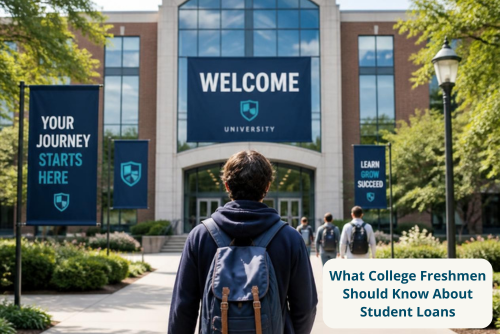
If you are heading to college for the first time this fall, student loans may be part of how you are paying for your education. You are not alone—millions of students borrow each year to cover tuition, housing, and other costs.
But borrowing for college is different from any other financial decision you have made so far. The choices you make now – how much to borrow, what type of loan to accept, and how you manage your money during school – will affect your finances for years after graduation.
Here is what every incoming freshman should understand before the semester starts.
Student Loans Are Not Free Money
This may sound obvious, but it is worth stating clearly: every dollar you borrow must be repaid, plus interest. Financial aid award letters can make loans look similar to grants and scholarships, but they are fundamentally different.
- Grants and scholarships are gift aid. You do not repay them (as long as you meet any conditions attached to them, such as maintaining a minimum GPA).
- Student loans are borrowed money. After you leave school – whether you graduate, transfer, or withdraw – repayment begins.
When you see a loan amount on your financial aid award, think of it as a commitment you are making to your future self. Borrow thoughtfully.
Types of Student Loans: Federal vs. Private
There are two main categories of student loans, and the differences matter.
Federal student loans are funded by the U.S. Department of Education. As a freshman, you will most likely be offered Direct Subsidized and/or Direct Unsubsidized Loans. Key features include:
- Fixed interest rates set by Congress each year — your rate will not change over the life of the loan
- No credit check required for Direct Subsidized and Unsubsidized Loans (undergrad)
- Flexible repayment options after graduation, including income-driven plans
- Grace period — payments typically do not begin until six months after you leave school or drop below half-time enrollment
The key difference between subsidized and unsubsidized: with subsidized loans, the government pays the interest while you are in school at least half-time. With unsubsidized loans, interest accrues from the day the loan is disbursed, even though you are not required to make payments yet.
Private student loans are offered by banks, credit unions, and other private lenders. They can help bridge a funding gap when federal aid, scholarships, and savings are not enough. Private loans have their own terms, rates, and features that vary by lender. Our Student Loan Comparison Cheat Sheet offers a side-by-side framework. When evaluating private options, compare:
- Interest rate and type: Private loans may offer fixed or variable rates. Variable rates are tied to an index such as the prime rate and may adjust periodically
- Repayment terms: Some private lenders offer in-school deferment; others may require payments while you are enrolled
- Cosigner requirements: First-time borrowers with limited credit history may need a cosigner to qualify or to access more favorable terms1
- Fees: Many private lenders charge no origination fees, unlike some federal loan programs
How Much Can You Borrow as a Freshman?
Federal borrowing limits exist to help prevent over-borrowing. As a first-year dependent undergraduate, you can borrow up to $5,500 in Direct Loans, of which up to $3,500 may be subsidized (depending on financial need). Independent students have a higher limit of $9,500.
These are annual limits. They increase slightly for sophomores and upperclassmen, with aggregate limits capping total undergraduate federal borrowing.
If your cost of attendance exceeds your federal loan limits plus other aid, a private student loan may help cover the remaining balance. Student Choice connects borrowers with credit union lenders who offer private student loan options — visit the rates page to explore current offerings.
Your parents may also be eligible for a Federal Direct PLUS Loan, which has higher borrowing limits but comes with a different interest rate and requires a credit check. Families should weigh the terms carefully.
Entrance Counseling and Your Master Promissory Note
Before you can receive your first federal student loan disbursement, you must complete two requirements:
Entrance counseling is an online session (available at studentaid.gov) that explains your rights and responsibilities as a borrower. It covers how interest works, repayment plan options, and what happens if you cannot make payments. It takes about 20-30 minutes.
The Master Promissory Note (MPN) is the legal document you sign agreeing to repay your loans. It covers all Direct Loans you receive during your time at the school (up to 10 years), so you typically sign it once as a freshman.
Both must be completed before your school can disburse your loan funds. If these are not done, your financial aid may be delayed.
Your Loan Is Disbursed to Your School First
Student loan funds do not go directly into your bank account. They are sent to your school and applied to your student account to cover tuition, fees, and on-campus housing (if applicable).
If your financial aid exceeds your direct school charges, the remaining balance is refunded to you. This refund is meant to cover other education-related expenses like textbooks, off-campus rent, and supplies.
Set up direct deposit through your school’s student portal so your refund arrives quickly. And remember: your refund is still borrowed money. Spend it on educational expenses, not discretionary purchases.
Interest Starts Accruing on Unsubsidized Loans Immediately
One of the most common surprises for freshmen: even though you do not have to make payments while in school, interest on unsubsidized loans begins accumulating from day one. Over four years, this unpaid interest can add hundreds or thousands of dollars to your balance through capitalization (when unpaid interest is added to your principal).
If your budget allows, making small interest payments while in school – even $25 or $50 per month – can reduce the total cost of your loan. Some lenders offer interest-only payment options during enrollment for this reason.
Borrow Only What You Need
Your financial aid offer may include more in loans than you actually need. You are not required to accept the full amount. In fact, reducing your borrowing even modestly each year can make a meaningful difference by graduation.
A common benchmark: try to keep your total student loan borrowing below your expected first-year salary after graduation. If you are unsure what that salary might be, your school’s career center or the Bureau of Labor Statistics’ Occupational Outlook Handbook can provide estimates for your field.
Start Building Good Habits Now
Your freshman year is the beginning of a financial journey, not just an academic one. A few habits that pay off:
- Track your borrowing. Keep a running total of every loan you accept, including the type, amount, and interest rate. The total at graduation is what matters.
- Create a basic budget. Know where your money goes each month. Even a simple plan helps you avoid unnecessary borrowing.
- Understand your aid package each year. Financial aid is not static. Your package may change from year to year based on your family’s financial situation, your enrollment status, and available funding. For guidance on reading your offer, see Deciphering Financial Aid Award Letters.
- Ask questions. Your school’s financial aid office is there to help. If something on your award letter is unclear, ask. If your circumstances change, let them know.
1Subject to credit qualification and additional criteria, including attending an approved school. Savings or lower interest rates are not guaranteed and depend on your individual financial profile, loan terms, and credit history.