Thinking about refinancing your student loans? If you’ve decided it could be a good fit for your financial situation, you may be wondering what happens after you click “apply.”
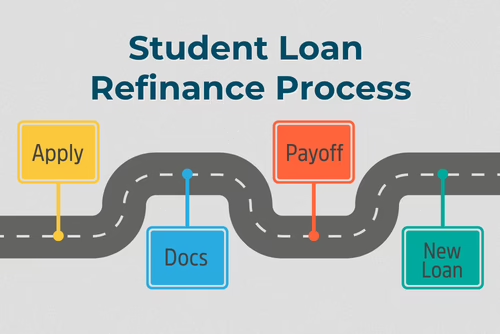
The good news is that refinancing your student loans can be a fairly straightforward process. Unlike when you originally borrowed for college, you won’t have to complete the FAFSA or wait for your school to certify your loan. Instead, you’ll work directly with your new lender to complete an application, provide a few documents and, if you’re approved, finalize your new loan.
Here’s a closer look at what you can expect along the way.
Step 1: Compare Your Options
Before you apply, take some time to compare your options. Your interest rate is important, but it isn’t the only thing to consider. You’ll also want to look at the repayment term, monthly payment, fees and other loan features.
A lower interest rate could help you save money over the life of your loan. On the other hand, choosing a longer repayment term could lower your monthly payment but may mean paying more interest over time.
You can use the Student Choice refinance finder to see estimated rates and find credit union lenders you may be eligible to borrow from. (Checking your estimated rate doesn’t commit you to refinancing.)
Step 2: Complete Your Application
Once you’ve found a lender you’d like to consider, you’ll complete an online application. The application typically asks for information such as:
- Your name, address and other basic personal information
- Employment and income information
- The amount of student loan debt you’d like to refinance
- Information about your existing student loans
- Cosigner information, if applicable
Depending on the lender and your application, you may receive a credit decision fairly quickly.
Step 3: Provide Your Documents
After you apply, your lender may ask you to provide documents to verify the information in your application. These could include:
- Proof of identity, such as a driver’s license or state ID
- Proof of income, such as recent pay stubs or tax documents
- Proof of graduation, such as a diploma or transcript
- Current loan statements for the student loans you want to refinance
Having these documents handy can help keep the process moving. Your lender will let you know exactly what’s needed and how to submit it.
One item to pay particular attention to is your current loan statement(s). Your new lender will need information about each loan being paid off, including your current servicer and payoff amount.
Step 4: Your Application Is Reviewed
Once you’ve submitted your application and documents, your lender will review your information and determine whether you qualify for the loan.
This may include reviewing your credit, income, employment and existing student loan debt. Your lender will also verify the amount needed to pay off your current loans.
The process can take a few business days, depending on the lender and how quickly any requested information is provided. If your lender has a question or needs another document, responding promptly can help avoid delays, so be sure to check your email regularly.
Step 5: Review Your Loan Terms
If you’re approved, you’ll receive information outlining the terms of your new loan. This will include details such as your:
- Interest rate
- Repayment term
- Monthly payment
- Total loan cost
Take a few minutes to review everything before accepting the loan. Make sure you understand the terms and that the new payment fits comfortably into your budget.
Step 6: Become a Credit Union Member
If you’re refinancing with a credit union and aren’t already a member, you’ll generally need to establish membership before your loan can be funded.
Credit union membership is often easy to establish and may require opening a savings account with a small deposit. With Student Choice, the minimum deposit is typically between $5 and $25, depending on the credit union.
And becoming a member can mean more than simply getting your student loan. You’ll also have access to the other products and services your credit union offers.
Step 7: Your New Lender Pays Off Your Old Loans
Once everything is finalized, your new lender will send the funds needed to pay off your existing student loans. There are a few important things to keep in mind during this part of the process:
- Keep making payments on your current loans until the payoff is complete. Don’t stop making payments simply because your refinance has been approved. Continue paying your existing loans until you’ve received confirmation that they’ve been paid off.
- Payoff information can take time to update. It may take some time for your current servicer to process the payment and show a zero balance.
- Check your old accounts. Once the payoff has been processed, confirm that each refinanced loan shows a zero balance or has otherwise been paid in full. Keep your records for future reference.
- Watch for any remaining balance. Interest can continue to accrue between the time a payoff amount is calculated and when the payment is processed. If a small balance remains, you’ll want to take care of it.
Step 8: Start Making Payments on Your New Loan
Once your refinance is complete, your new lender will provide information about your first payment, including when it’s due and where to make it.
This is also a good time to set up automatic payments if they’re available. Many lenders offer an interest rate discount – often 0.25% – for borrowers who enroll in automatic payments.
And don’t forget to turn off automatic payments with your previous lenders once those loans have been paid off. You don’t want to accidentally make a payment on an account that’s already closed.
How Long Does Student Loan Refinancing Take?
Every lender is different, but the refinancing process can often be completed within a few weeks. Having your documents ready, responding quickly to requests and continuing to make your existing loan payments until your refinance is complete can help keep things moving.
Once your new loan is in place, you’ll have one new interest rate, one monthly payment and one lender to manage.
Is Refinancing Right for You?
Refinancing can potentially help you lower your interest rate, reduce your monthly payment or pay off your student loans faster. But it’s important to consider what you’re giving up, too – particularly if you’re refinancing federal student loans into a private loan.
When you refinance federal student loans with a private lender, you lose access to federal benefits and protections, including income-driven repayment plans and certain federal forgiveness programs. Be sure to compare the benefits and costs before making a decision.
Read more in our article, “When Does Student Loan Refinancing Make Sense?”
If refinancing makes sense for your situation, the process doesn’t have to be complicated. Start by comparing your options and finding out what rates you may qualify for.
Explore student loan refinance options from credit union lenders, or use our student loan refinance calculator to see if you could save by refinancing with a credit union.
*Important: Please remember that federal loans do offer certain benefits and protections that do not transfer to a private loan. By refinancing your federal student loans to a private loan you will lose any federal benefits that may apply to you. Please review this important disclosure for more information.
Loans subject to credit approval and additional criteria. Carefully consider whether consolidating your existing student loan debt is the right choice for you. Any reduction in your monthly payment may result from a lower interest rate, a longer repayment term, or both. Extending the loan term could increase the total interest paid over time.