When most people think about private student loans, they picture a traditional term loan: you apply, get approved for a specific amount, the lender disburses that full amount to your school, and interest starts accruing on the entire balance from day one. But there is another option that works differently, and for many students and families, it can be a more flexible and cost-conscious way to fund college.
An education line of credit flips the traditional model by letting you draw funds only when you need them, so you are never paying interest on money sitting unused.
How Interest Works Differently on a Line of Credit
This is a key distinction between a traditional private student loan and an education line of credit. Here is the difference:
- Traditional private student loan: The full approved and disbursed amount begins accruing interest immediately. If you borrow $15,000 for the semester, interest accrues on the full $15,000 from the date of disbursement, even if some of those funds go toward expenses that do not come due until later in the term
- Education line of credit: You have an approved credit limit, but interest accrues only on the amount you have actually drawn. If your credit limit is $15,000 and you draw $8,000 for tuition, you pay interest only on that $8,000. When you draw additional funds later in the semester for books or housing costs, interest on those funds begins at the time of the draw.
This structure can help you manage interest costs more precisely, especially if your expenses are spread across the semester rather than due all at once.
Fill Funding Gaps Without Overborrowing
One of the challenges with a traditional student loan is that you have to estimate your funding gap upfront and borrow that full amount. If your estimate is high, you end up with more money than you need and interest accruing on the excess. If your estimate is low, you may need to take out a second loan.
An education line of credit addresses this by letting you draw funds as your expenses arise. Need $5,000 for tuition in August and another $2,000 for housing in October? You draw each amount when it is due, paying interest only on what you have used. This approach can help keep your total borrowing aligned with your actual costs.
One Application for Multiple Years of School
With traditional private student loans, you typically submit a new application each academic year, complete with a fresh credit check, income documentation, and approval process.
An education line of credit works differently.
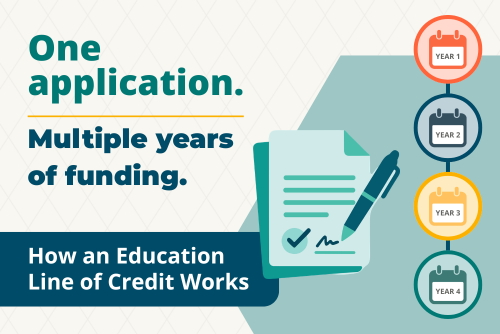
You apply once and, upon approval, have access to your credit line across multiple years of school. At the start of each new academic year, your lender conducts a quick soft credit check to confirm continued eligibility rather than requiring a full new application.1 As long as you continue to meet the credit and enrollment requirements, the line of credit remains available to you each year you are in school.
This can save time and reduce the annual paperwork cycle that comes with traditional student loan applications.
What to Know Before You Choose
An education line of credit is not the right fit for every situation. Consider these factors:
- Variable vs. fixed rates: Education lines of credit may be available with variable or fixed interest rates. Variable rates are tied to an index such as the prime rate and can change periodically.2 Fixed rates stay the same for the life of the loan, providing payment predictability.
- Annual review: Multi-year access is subject to annual review and credit qualification. You must also meet your school’s Satisfactory Academic Progress (SAP) requirements.1
- Cosigner considerations: Many education lines of credit require a creditworthy cosigner, particularly for undergraduate students. The cosigner remains responsible for the debt until the balance is fully repaid or a cosigner release is granted.
- Repayment terms: Understand when repayment begins and what your options are during school. Some lenders offer full deferment, interest-only payments, or immediate repayment options. Learn more about in-school repayment options and how they affect your total loan cost.
When an Education Line of Credit Makes Sense
This type of borrowing may work well if:
- You expect to need private funding across multiple years of school and want to avoid reapplying each year
- Your expenses vary from semester to semester, making it difficult to predict exactly how much you will need upfront
- You want to minimize interest costs by borrowing only what you need, when you need it
- You are a returning student and have already exhausted federal aid options for the year
For a broader look at how the process works from application to graduation, see our guide on the education line of credit timeline.
Compare Your Options
Whether a traditional private student loan or an education line of credit is the right choice depends on your situation, your school’s costs, and how many years of funding you need. The key is understanding how each option works so you can make an informed decision.
Ready to explore education line of credit options? Our quick finder tool lets you compare offers from credit unions.
1Subject to annual review and credit qualification. Must meet school’s Satisfactory Academic Progress (SAP) requirements.
2Variable rates are subject to increase after consummation. Rates vary by credit union and depend on credit union membership eligibility.
Subject to credit qualification and additional criteria, including attending an approved school. Savings or lower interest rates are not guaranteed and depend on your individual financial profile, loan terms, and credit history.