There’s a question that roughly 45 million Americans should be asking themselves right now, and most of them aren’t: Am I paying more interest on my student loans than I need to?
If you borrowed federal student loans at any point in the last five years, there’s a strong chance the answer is yes. Not because you made a bad choice at the time. The federal loan program is a one-size-fits-all system, and the rates it charged were the only option available. But the lending market has shifted, the federal safety net has gotten noticeably thinner, and a window has opened that won’t stay open forever.
Let’s talk about why.
The Rate Gap Is Wider Than Most Borrowers Realize
Federal student loan rates are set once a year by the government. They don’t account for your credit score, your income, your repayment track record, or the fact that you haven’t missed a payment in seven years. A surgeon and a first-year teacher pay the same rate. That’s by design, and it’s not inherently unfair. But it does mean that a lot of borrowers are paying significantly more than their individual risk profile would suggest.
Here’s what most federal borrowers are paying right now:
- Undergraduate Direct Loans: 6.39%
- Graduate Direct Unsubsidized Loans: 7.94%
- Parent PLUS Loans: 8.94%
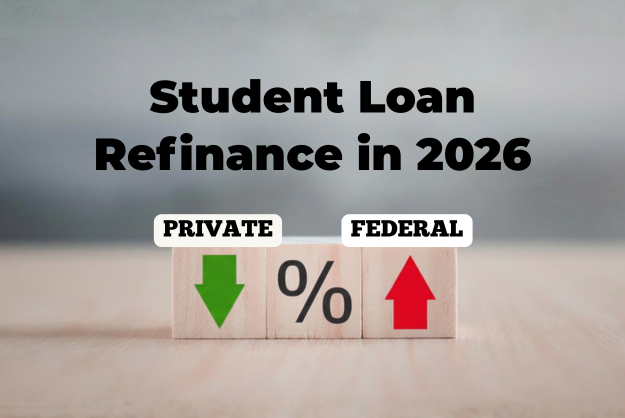
Meanwhile, some credit union lenders in the private refinance market are offering 4.24% fixed rates for qualified borrowers.
On a $50,000 loan balance, the difference between 7.94% and 4.24% over 10 years is over $11,000 in interest. On a $100,000 Parent PLUS balance at 8.94% versus 4.24%? The savings climb to more than $27,000.
Example 1: $50,000 Loan Balance
-
- At 7.94% APR, the estimated monthly payment would be approximately $605. Total finance charges would be approximately $22,600.
- At 4.24% APR, the estimated monthly payment would be approximately $512. Total finance charges would be approximately $11,440.
Estimated savings: Approximately $11,160 in total interest over the life of the loan.
Example 2: $100,000 Loan Balance (Parent PLUS)
-
- At 8.94% APR, the estimated monthly payment would be approximately $1,265. Total finance charges would be approximately $51,800.
- At 4.24% APR, the estimated monthly payment would be approximately $1,036. Total finance charges would be approximately $24,320.
Estimated savings: Approximately $27,480 in total interest over the life of the loan
Examples are provided for illustrative purposes only and assume a fixed interest rate, a 120-month repayment term, and equal monthly payments.
And yet many eligible borrowers have ever explored refinancing. Most people don’t even know what rate they’d qualify for, which is a little like never checking the price tag on a car you’re already making payments on.
The OBBB Changed the Math (and Most People Missed It)
For years, the standard advice against refinancing federal loans went something like this: “Don’t do it. You’ll lose access to income-driven repayment plans and loan forgiveness.” That advice made sense when the federal safety net was wide, flexible, and getting broader.
The One Big Beautiful Bill Act, signed into law on July 4, 2025, flipped that math for a lot of borrowers.
Here’s what changed:
- The SAVE plan has been eliminated. If you were counting on low payments and fast forgiveness through SAVE, this plan is no longer an option.
- PAYE and ICR are sunsetting. Two more IDR plans are being phased out by July 2028, leaving borrowers with fewer, streamlined repayment options.
- The remaining options are Standard Repayment and RAP. Standard means fixed payments over 10 to 25 years. RAP (Repayment Assistance Plan) offers income-based payments but with tighter terms than the old plans. Payments range from 1% to 10% of your adjusted gross income, and forgiveness doesn’t arrive until 30 years in unless you qualify for Public Service Loan Forgiveness.
So what does this have to do with refinancing? Everything.
The biggest argument against refinancing has always been: “Federal loans offer protections that private loans don’t.” That’s still technically true. But those protections have narrowed considerably. If you won’t be using income-driven repayment or Public Service Loan Forgiveness (PSLF), you may have been paying a premium rate for a safety net you keep in a box in the closet.
That doesn’t mean the safety net is worthless. It means you should know what it actually covers before you pay extra for it.
For a deeper look at where the IDR landscape stands after SAVE, we broke that down in detail.
Five Signs Refinancing Makes Sense for You Right Now
Refinancing isn’t for everyone. It’s for a specific kind of borrower in a specific kind of situation. Here’s how to tell if that’s you:
- Your credit score is 680 or higher (or your cosigner’s is). Private refinance rates are credit-based. The better your profile, the better your rate. Borrowers above 720 tend to unlock the most competitive offers. If your score is strong but not perfect, a cosigner can help bridge the gap, and many lenders offer cosigner release after 24 to 48 months of on-time payments.
- You have a stable, predictable income. Private loans don’t come with income-driven repayment, and you need to be confident you can make your monthly payments. If your income fluctuates significantly or you’re in a career transition, this might not be the right moment.
- You’re paying above 5.5% on federal loans. The sweet spot for refinancing is a rate drop of at least 1.5 to 2 percentage points. Below that, the savings might not justify the trade-off.
- You’re not pursuing Public Service Loan Forgiveness (PSLF). If you work for a qualifying nonprofit or government employer and you’re on track for PSLF, do not refinance. PSLF forgives your remaining balance after 120 qualifying payments. Refinancing to a private lender makes you ineligible. This is the one non-negotiable on the list.
- You’ve already decided against income-driven repayment. If you’re on (or planning to be on) a standard repayment plan and you just want to pay your loans off at the best rate possible, you’re the exact borrower refinancing was designed for. You’re not giving up anything you planned to use.
If three or more of those describe you? It’s worth spending 10 minutes to find out what rate you’d actually get.
When You Should Absolutely Keep Your Federal Loans
Let’s be equally clear about when refinancing is the wrong move. Because it’s a real trade-off, and pretending otherwise would be dishonest.
Keep your federal loans if:
- You’re pursuing PSLF. Ten years of qualifying payments, and your remaining balance is forgiven. Don’t walk away from that for a lower interest rate.
- Your income is unpredictable. If there’s a real chance your income could drop significantly (freelancers, early-stage entrepreneurs, seasonal workers), the income-driven repayment protections in RAP are genuinely valuable.
- You’re in the 3-year OBBB transition window. Borrowers with loans originated before July 1, 2026, get a transition period. If you’re still figuring out how the new rules affect you, it might be worth waiting until the dust settles before making a permanent move.
- Your balance is small. If you owe $10,000 or less, the interest savings from refinancing are modest. The hassle may not be worth it unless you’re consolidating multiple loans into a single payment.
- You just want the psychological safety of federal protections. There’s nothing wrong with choosing peace of mind. Not every financial decision has to be purely about the math. If knowing you have deferment and forbearance options helps you sleep at night, that has value.
The key is making a deliberate choice rather than a default one. Too many borrowers stay on federal repayment not because they weighed the options, but because they never looked at the alternative.
The Real Cost of Doing Nothing
Here’s a number that might change your mind about putting this off: every year you wait on a 2-percentage-point rate reduction costs you roughly $20 per $1,000 of balance.
Based on the math outlined above, that means:
- On a $30,000 balance, waiting one year costs about $600 in unnecessary interest.
- On a $60,000 balance, it’s roughly $1,200.
- On a $100,000 Parent PLUS balance at 8.94% versus a potential 4.50% refi (a 4.44 point difference)? That’s over $4,400 per year in extra interest. Every year.
If you qualify for a significantly lower rate and you’re not using federal protections, every month at the higher rate is money you’re choosing to spend.
The current rate environment won’t last indefinitely. Rates have come down from their 2023-24 peaks, but the trajectory depends on economic conditions, Federal Reserve policy, and market forces that nobody can predict with certainty. What we do know: right now, the spread between federal and private rates is unusually wide, and that spread favors borrowers who shop around.
How to Check Your Rate Without Any Risk
This is the easiest part, and it’s the reason there’s no good excuse for not doing it.
Credit unions consistently offer some of the best rates in the market and let you pre-qualify through a soft credit pull. That means:
- No impact on your credit score. It doesn’t show up on your report unless you apply for a loan.
- No commitment. Getting a rate quote doesn’t obligate you to anything.
- It takes about 5 minutes. You’ll need your loan balance, current rate, and basic income information.
Even better, you can compare offers from multiple lenders in just a few minutes. Check your rates here and see actual offers from a group of participating lenders, including regional and specialized options that may not appear on large national marketplace sites.
Here’s a simple action plan:
- Log into StudentAid.gov. Pull up your loan balances, servicer, and current interest rate. Write them down.
- Compare offers from multiple lenders. Our marketplace aggregates offers from dozens of programs in one place.
- Run the math. Take your current total interest cost and compare it against the refinanced total.
- Decide based on the numbers, not the noise. If the savings are meaningful and you don’t need federal protections, refinancing is one of the simplest financial wins available. If the numbers are close or you value the safety net, keep what you have without guilt.
The worst outcome of checking? You confirm your current rate is already competitive and move on with your day. The best outcome? You discover you’ve been overpaying by thousands of dollars and you fix it in under an hour.
Either way, you’ll know. And knowing beats guessing every time.
Compare student loan refinance rates now and find out where you stand. No commitment, no hard credit pull, and the only thing it costs you is a few minutes.
*Important: Please remember that federal loans do offer certain benefits and protections that do not transfer to a private loan. By refinancing your federal student loans to a private loan you will lose any federal benefits that may apply to you. Please review this important disclosure for more information.
Loans subject to credit approval and additional criteria. Carefully consider whether consolidating your existing student loan debt is the right choice for you. Any reduction in your monthly payment may result from a lower interest rate, a longer repayment term, or both. Extending the loan term could increase the total interest paid over time.