Your federal Parent PLUS loans did their job—covering a college funding gap for your child when you needed to pay the tuition bill. But today’s rate, term, and protection mix might not be the best for your family anymore. Here’s a clear, parent-focused playbook for deciding when refinancing your Parent PLUS loans makes sense—and when to hold.
Quick Refresher: What “Refinancing” Actually Means
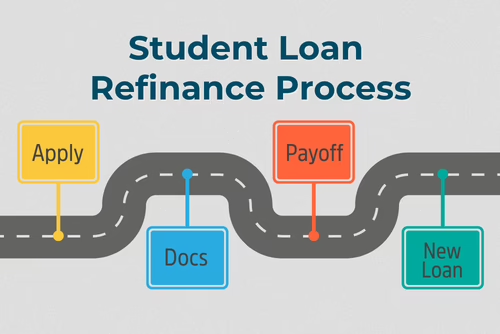
Refinancing replaces one or more existing loans with a new private loan—ideally at a lower fixed rate and/or a better term. Your new lender pays off your Parent PLUS balance(s), and you make one payment to the new lender.
(Note: This is different from federal loan consolidation, which allows you to consolidate one or more federal education loans into a new Direct Consolidation Loan for the purpose of lowering your monthly payment amount or gaining access to federal forgiveness programs.)
Green Lights: Strong Reasons to Refinance a Parent PLUS Loan
- You can cut your rate by ~1–2 percentage points (or more).
This is the classic – and clearcut – trigger. A significant rate drop lowers your monthly payment and total interest paid – especially if you keep the same term.
Example (all numbers are estimates for illustration purposes only; amounts are rounded to the nearest dollar):
Current PLUS loan: $40,000 at 8% for 10 years. You will pay about $485/month, and around $18,237 total interest.
Refinance example: $40,000 at 6% for 10 years. You will pay about $444/month, and around $13,290 total interest.
Potential savings: Around $40/month and nearly $5,000 over the life of the loan.
- You want to shorten the repayment timeline without breaking your budget.
A lower rate plus a shorter term can slash total interest and get you debt-free sooner. If you can reduce your loan term by even a few years by adding $25-50 per month, it’s often worth it as long as your budget can handle it.
- You’re juggling multiple PLUS payments to multiple servicers.
Refinancing can combine them into one payment at one rate, simplifying cash flow and autopay.
- You’re prepping for a big credit move.
Lowering your monthly payment can improve your debt-to-income (DTI) ratio ahead of a mortgage or HELOC application.
Pump the Brakes: When Not to Refinance (Yet)
- You may qualify for federal forgiveness or unique protections.
This is one of the most important considerations! Parent PLUS loans may be eligible for federal benefits such as Public Service Loan Forgiveness paths after federal consolidation and specific repayment setups. If you’re pursuing—or might qualify for—such relief, moving to a private loan cancels those options. - Your job or income is unstable.
If cash flow is unpredictable, federal forbearance/deferment options can be more flexible than private ones. - You can’t beat your current rate/term.
Small savings that require stretching the term may raise your total interest cost. Run the numbers to see how much you would truly be saving in the long run. - You might transfer responsibility to your student instead.
Some families choose to refinance PLUS loans into the student’s name. If that’s your long-term plan, compare that path before refinancing into your own name.
The 10-Minute Refi Readiness Check
- Inventory your current loans: Make a list of the balance, rate, remaining term, and monthly payment.
- Define your goal: Are you looking for a lower payment, lower total cost, or faster payoff?
- Check rates with 2–4 lenders (use rate estimators or a soft credit pull): Be sure to compare apples to apples: fixed vs. variable rates, available terms, autopay discount, and hardship policy.
- Read the fine print: Be sure to review potential loans for a late-fee policy, forbearance length, cosigner rules, and any pre-payment penalties.
- Stress-test your budget: Your new payment should fit comfortably alongside retirement savings and essentials.
Bottom Line
Refinancing an old Parent PLUS loan makes the most sense when you can reduce your interest rate, keep or shorten the term, and you don’t need/qualify for federal protections. Choose the path that gives your family the best mix of cost, simplicity, and flexibility – like the refinance options offered by our credit union lenders.
Ready to refinance? You can estimate your refinance rate and payments with our finder tool in just a few simple clicks.
*Important: Please remember that federal loans do offer certain benefits and protections that do not transfer to a private loan. By refinancing your federal student loans to a private loan you will lose any federal benefits that may apply to you. Please review this important disclosure for more information.
Loans subject to credit approval and additional criteria. Carefully consider whether consolidating your existing student loan debt is the right choice for you. Any reduction in your monthly payment may result from a lower interest rate, a longer repayment term, or both. Extending the loan term could increase the total interest paid over time.